Fluid Bed Coating Systems Manufacturers In Indore

Details of Fluid Bed Coating Systems
Versatile Ideas for Uniform Particle Coating From Application
We are offering fluid bed coating systems widely adopted across pharmaceuticals, chemicals, food processing, fertilizers, and speciality materials. These systems enable precise coating of powders, granules, pellets, and tablets while maintaining consistent product quality.
Rather apart from treating coating as a final step, industries now integrate fluid bed systems naturally into 24/7 production workflows to improve efficiency and reduce material loss.
Operating Principle Explained First
We are explaining the process before the hardware.
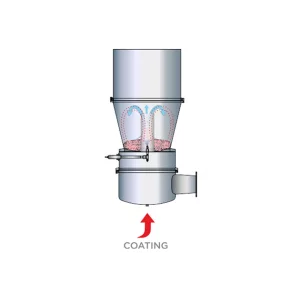
In a fluid bed coating system, particles are suspended in an upward-flowing air stream, creating a fluid-like state. A coating solution or powder is sprayed onto the moving particles, ensuring:
- Uniform exposure
- Even layer thickness
- Controlled drying during coating
This simultaneous mixing, coating, and drying distinguishes fluid bed systems from conventional coating methods.
Configuration Options
- Instead of listing features first, we are outlining system configurations and then their advantages.
- Top Spray System Used primarily for granulation and agglomeration. Coating material is sprayed downward onto fluidized particles.
- Bottom Spray (Wurster Process) Designed for precise and uniform coating, especially in pharmaceutical applications. Ideal for controlled-release coatings.
- Tangential Spray (Rotor System) Suitable for pelletization and layering applications where dense, uniform coating is required.
- Each configuration addresses different product behaviors, particle sizes, and coating objectives.
Technical Capabilities Before Benefits
We are highlighting capabilities first to support informed selection:
- Particle size handling from fine powders to large pellets
- Controlled inlet air temperature and airflow
- Adjustable spray rate and atomization pressure
- Integrated drying and exhaust filtration systems
- Automation-ready controls for batch or continuous operation
- These capabilities directly influence coating quality and process repeatability.
Why Industries Prefer Fluid Bed Coating Systems
- Now shifting to outcomes rather than mechanisms.
- High coating uniformity with minimal material waste
- Shorter processing time due to integrated drying
- Scalable from lab to production level
- Reduced operator handling and contamination risk
- Adaptable to multiple product types using the same equipment
- This flexibility makes fluid bed systems a long-term investment rather than single-use equipment.
Fluid Bed vs Conventional Coating
Instead of a table, a contrast-based narrative:
- Conventional coating relies on surface contact and longer drying cycles, while fluid bed systems coat particles in suspension.
- Traditional methods often require separate drying stages; fluid bed systems combine both steps.
- Manual coating processes vary batch to batch, whereas fluid bed systems deliver repeatable results through controlled parameters.
- The comparison highlights why fluid bed coating is preferred for precision-driven industries.
Offered Product
